Tugger train
A connected tugger train system no longer stops rigidly at every station, only at those where goods are ready for collection. Real-time data on position, load and orders controls milk runs flexibly and keeps assembly lines supplied on time.
Tugger train at a glance
Most frequent in the projects on this page
Use cases
Industries
Users in these projects

Verified projects featuring Tugger train






Tugger train system: milk runs on demand, not fixed loops
The transport management application of the Nexeed Industrial Application System from Bosch Connected Industry knows every vehicle with its load capacity and scheduled route. Combined with real-time data on loading status, position and load factor, it selects the right milk run for each new transport order. Drivers see the stations to be served, the load and the destination on a tablet. Automated tugger trains can be connected to a central control system via the VDA 5050 interface standard, which coordinates them together with mobile robots from other manufacturers.
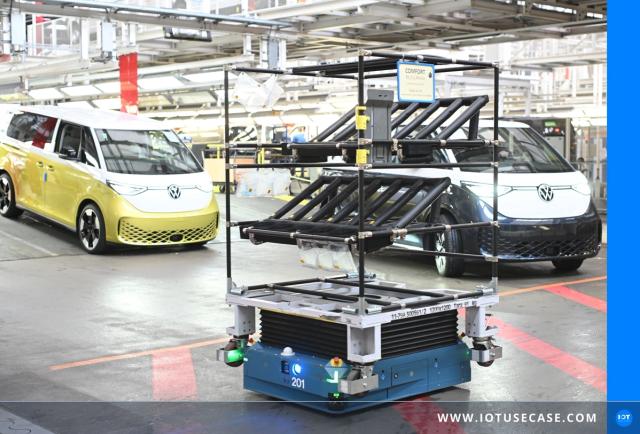
Both examples concern material supply in production. At Volkswagen Commercial Vehicles in Hannover-Stöcken, the SYNAOS control system manages almost 100 underride robots from MLR and 40 Linde tugger trains automated by Goetting. The vehicles deliver just-in-sequence material to the interlinked assembly lines, move 9,000 racks a day and cover around 300,000 kilometres a year. In the Bosch Connected Industry solution, the tugger train skips sub-routes for which no delivery order is currently registered. Podcast episode #45 describes this transport management for internal material flow.
Podcast episodes featuring Tugger train
Tugger train systems: frequently asked questions
How does dynamic milk run logistics work?
A dynamic milk run only stops at stations where goods actually need to be collected or delivered. The software from Bosch Connected Industry plans transport requirements in real time and continuously checks which new orders can sensibly be added to the current route. Sub-routes without a delivery order are dropped. A tablet shows the driver the stations, load and destination, which improves the utilisation of the tugger trains.
How is an autonomous tugger fleet controlled centrally?
Automated tugger trains handle transport between the logistics supermarket and the line, managed by a central control system. Since 2021, almost 100 underride robots and 40 automated tugger trains have been supplying the production lines at Volkswagen Commercial Vehicles in Hanover with bulk material, vehicle parts and body parts. All of them communicate via VDA 5050 with the SYNAOS platform, which reliably controls more than 135 devices and ensures a constant daily supply of material.
How does tugger train automation support just-in-sequence supply?
They deliver sequenced material to the right line at the right moment. At Volkswagen Commercial Vehicles, material arrives from the truck ramps in large load carriers and goes first to internal supermarkets. There, an employee places the just-in-sequence containers on a transfer point, after which the SYNAOS control system takes over and brings the material to the line automatically. Because the lines are interlinked, any late sequence immediately affects the whole system.
How does software handle tugger train planning on demand?
The tugger train collects goods from the supermarket and only stops at stations where there is current demand. In the Nexeed Industrial Application System from Bosch Connected Industry, every vehicle is stored with its load capacity and scheduled route. Together with the current loading status, position and load factor, the software selects the right milk run for new transport orders. Paper-based manual processes disappear, and the material flow becomes transparent.
More assets in “Conveying and Handling Technology”

Automated guided vehicle (AGV)
An AGV system brings material automatically from the warehouse to the line when a central fleet controller coordinates the automated guided vehicles (AGV). With IoT, sensors trigger transport orders and vehicles from different manufacturers run in one system.

Crane
Predictive crane maintenance with IoT focuses on the cable carrier, which guides power and data cables to the trolley. Sensors report overload or breakage before the crane comes to a standstill and give maintenance and replacement recommendations.

Industrial robot
Predictive robot maintenance with IoT brings the condition and performance data of industrial robots together on one platform. Operators detect faults and wear before a robot comes to a standstill, and manufacturers identify maintenance cases remotely.

Conveyor belt
Conveyor belt maintenance with IoT relies on sensors that capture vibration, temperature and the condition of the belt and belt cleaners. Operators detect damage such as a torn belt early, plan maintenance as needed and avoid costly line stoppages.
Forklift truck
Forklift tracking with IoT shows where every forklift truck is, which pallet it carries and where that pallet belongs. RFID, UWB and cameras replace manual scanning and document putaway, retrieval and loading automatically.

High-bay warehouse
In a high-bay warehouse, IoT links storage locations, forklifts and warehouse management through real-time data. Staff see on large screens which orders are due next, and pallets are put away and retrieved without manual scanning.
IIoT Use Case user group
What no project tells you
What did the project cost? Which sensor didn't survive in the field? How did you get maintenance on board? 300+ industrial users discuss questions like these with each other every month, openly and without vendors in the room.
Frequent topics in these projects, bring your questions:
- Fleet Management
- Asset Management
Online every month
Alternating tech and business focus
Users only
No sales pitches, exchange under NDA
300+ members
OT, IT and IIoT leads from industry