High-bay warehouse
In a high-bay warehouse, IoT links storage locations, forklifts and warehouse management through real-time data. Staff see on large screens which orders are due next, and pallets are put away and retrieved without manual scanning.
High-bay warehouse at a glance
Most frequent in the projects on this page
Use cases
Industries
Users in these projects


Verified projects featuring High-bay warehouse





OPC UA Andon visualisation keeps assembly and logistics in sync
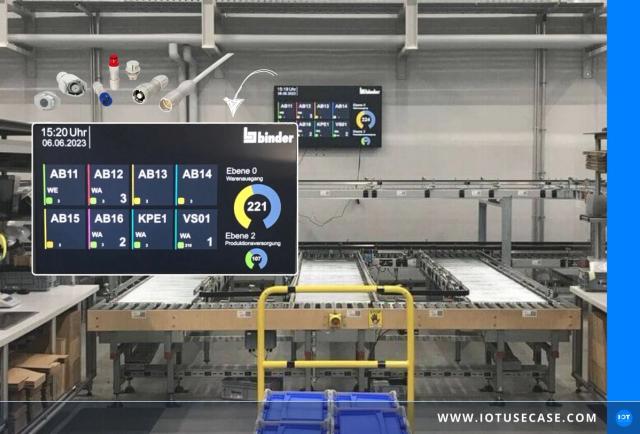

Shopfloor visualisation of SAP and non-SAP data for transparent logistics
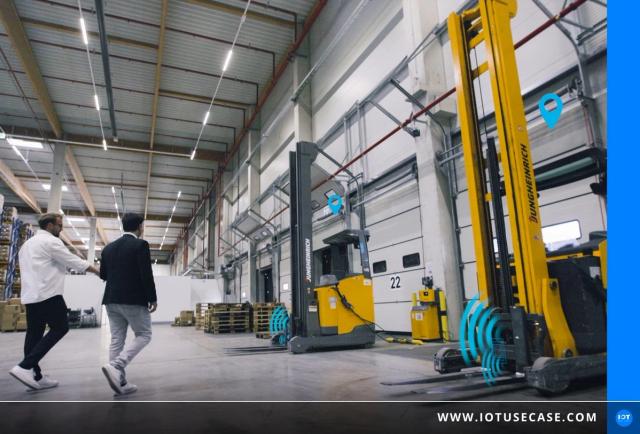



40% process acceleration in the warehouse with IoT
High-bay warehouse with IoT: orders and material flow live
The data comes from warehouse management and plant control: the solution examples connect SAP EWM with the SAP EWM/MFS material flow system, SAP Business One and Siemens S7 controllers. The low-code platform Peakboard turns this into picking and shipping orders, priorities and the work queue of individual workstations, without additional middleware. For localisation, INTRANAV combines RFID labels on parcels and rack locations with UWB technology on the forklifts. A local Edge Unit pre-filters the sensor data and sends it to the cloud application via secured MQTT.
The examples come from mechanical engineering, technology and retail. At PistenBully, two Peakboard andon boards show the material flows for the high-bay and small-parts warehouses so that both can serve the assembly line's three-hour cycle. Connector manufacturer binder, whose automated high-bay warehouse supplies production in Neckarsulm, keeps around 40 employees in the logistics hall and control room informed in real time about open deliveries, outgoing goods and faults. Textile wholesaler TB International increased efficiency in full-carton handling by almost 40 percent with INTRANAV's smart warehouse solution.
Podcast episodes featuring High-bay warehouse
High-bay warehouse: frequently asked questions
Which software shows material flow in a high-bay warehouse?
Visualisation software that brings SAP data onto screens in the warehouse. At PistenBully, two Peakboard andon boards show the material flows for the high-bay and small-parts warehouses: current picking and shipping orders, priorities and processing status with open, completed and running waves. Staff can see at a glance which orders are due next, and both warehouses reliably serve the assembly line's three-hour cycle.
How is an automated high-bay warehouse connected to production?
Through the warehouse management and material flow system, whose data appears on dashboards in the hall and control room. At binder, an automated high-bay warehouse acts as the vertical backbone supplying assembly in Neckarsulm, mapped in SAP EWM and SAP EWM/MFS. Peakboard connects these systems, Excel, Outlook and the Siemens S7 controller without additional middleware. Around 40 employees see open deliveries by load carrier type, work queues and outgoing goods in real time.
How does RFID help with put-away in a high-bay warehouse?
Storage locations and pallets are identified automatically, and every put-away is booked without a scanner. At TB International, the locations in the high-bay warehouse carry RFID labels. A forklift equipped with RFID and UWB technology recognises which pallet it is picking up and where it should be stored; a tablet shows the driver the nearest free location on an optimised route. The completed put-away is booked automatically in the SAP Business One ERP system.
How does real-time data speed up picking in a high-bay warehouse?
Real-time data shows which orders are due and where support is needed right now. At binder, staff can see on the dashboard when outgoing goods are busier than incoming goods and switch workstations on their own initiative. Peakboard also converts quantities into load units, for example 45 KLT3 and 60 KLT4 boxes still to be stored. At TB International, an RFID gate automatically checks retrieved goods for completeness.
More assets in “Conveying and Handling Technology”

Automated guided vehicle (AGV)
An AGV system brings material automatically from the warehouse to the line when a central fleet controller coordinates the automated guided vehicles (AGV). With IoT, sensors trigger transport orders and vehicles from different manufacturers run in one system.

Crane
Predictive crane maintenance with IoT focuses on the cable carrier, which guides power and data cables to the trolley. Sensors report overload or breakage before the crane comes to a standstill and give maintenance and replacement recommendations.

Industrial robot
Predictive robot maintenance with IoT brings the condition and performance data of industrial robots together on one platform. Operators detect faults and wear before a robot comes to a standstill, and manufacturers identify maintenance cases remotely.

Conveyor belt
Conveyor belt maintenance with IoT relies on sensors that capture vibration, temperature and the condition of the belt and belt cleaners. Operators detect damage such as a torn belt early, plan maintenance as needed and avoid costly line stoppages.
Forklift truck
Forklift tracking with IoT shows where every forklift truck is, which pallet it carries and where that pallet belongs. RFID, UWB and cameras replace manual scanning and document putaway, retrieval and loading automatically.

Welding robot
A connected industrial welding robot delivers cycle times, piece counts and status messages in real time. Operators make downtime visible, balance the utilisation of their robot lines and integrate the robots into end-to-end order control.
IIoT Use Case user group
What no project tells you
What did the project cost? Which sensor didn't survive in the field? How did you get maintenance on board? 300+ industrial users discuss questions like these with each other every month, openly and without vendors in the room.
Frequent topics in these projects, bring your questions:
- Condition Monitoring
- Corrective maintenance
- Asset Tracking/ Track and Trace
Online every month
Alternating tech and business focus
Users only
No sales pitches, exchange under NDA
300+ members
OT, IT and IIoT leads from industry