Industrial robot
Predictive robot maintenance with IoT brings the condition and performance data of industrial robots together on one platform. Operators detect faults and wear before a robot comes to a standstill, and manufacturers identify maintenance cases remotely.
Industrial robot at a glance
Most frequent in the projects on this page
Use cases
Technologies
Users in these projects

Verified projects featuring Industrial robot



Robots for construction chemicals in prefabricated construction


IIoT building blocks for predictive quality
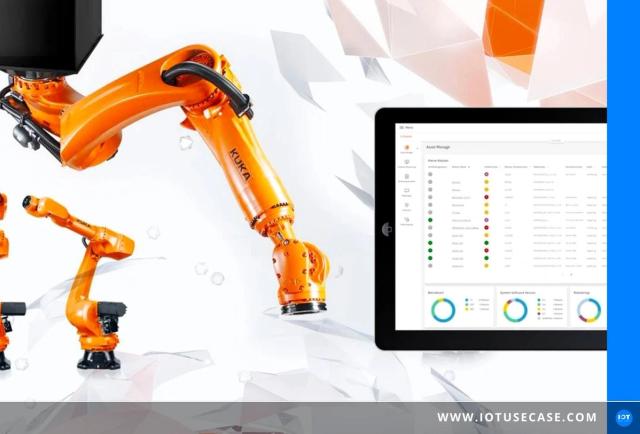





From reactive to proactive system with the intelligent software platform KUKA iiQoT






Robots as asset-as-a-service: a rental model for industry



Partnership on the shop floor for outsourced services in robotics
Predictive robot maintenance: from reactive to proactive operation
In the solution examples, a cloud connector from Device Insight retrieves the data from the robot and transfers it to the cloud via OPC UA and MQTT, secured with Microsoft Azure functions. Wandelbots equips robots with Infineon sensors for position and performance data, and the position is determined by sensor fusion of radar and 3D cameras. An AI at the edge evaluates the data, and a second application on the SAP Business Technology Platform detects wear on the tools at the robot head. In the B&R, Harting and SICK project, miniaturised sensors connect older robots to IT via Single Pair Ethernet and OPC UA over TSN.
The examples come from the automotive industry, automation, mechanical engineering and chemicals, mostly as condition monitoring, predictive maintenance or a new service model. With the KUKA iiQoT platform, developed with Device Insight, KUKA bundles the data of entire robot fleets per line, cell or individual robot and turns maintenance cases directly into service orders. Wandelbots has tested a rental model at the Smart Systems Hub in Dresden in which users pay, for example, per unit produced, so far as an MVP. For a chemicals company, daenet developed a robotic solution for foaming prefabricated house walls, so employees no longer handle industrial foams directly.
Podcast episodes featuring Industrial robot
Smart Manufacturing Kaizen Level (SMKL) – data acquisition, visualization, analysis and optimization for customers
KUKA platform iiQoT: Cloud-based IIoT software enables visualization and troubleshooting
Pay-per-use platform for robots: Wandelbots, SAP and Infineon in the "Digital Product Factory" innovation process
Robot maintenance with IoT: frequently asked questions
How does IoT make robot maintenance predictive?
IoT makes robot maintenance predictive because condition data such as motor temperature flows continuously into one platform. With conventional solutions, assessing a robot's condition in real time was not possible. KUKA iiQoT bundles the data of the whole fleet, filters out, for example, robots with a certain motor temperature or an operating system that needs updating, and provides guidance parameters that make messages easier to interpret. Maintenance cases can be identified remotely.
How does robots as a service work with IoT?
With robots as a service, the user does not pay for the robot but for its use, for example per unit produced. This requires performance data and order data to come together. In the Wandelbots testbed with Infineon, SAP and Objective Partner in Dresden, a digital twin in the cloud controls and monitors the robot's work. It is built from sensor data and skills and provides the basis for precise billing. So far, the solution is an MVP.
How secure is cloud-based robot monitoring?
It can be secured without connecting the plant network directly to the internet. For KUKA iiQoT, Device Insight developed its own cloud connector, which retrieves the data from the robot and transfers it to the cloud via OPC UA and MQTT. It uses Microsoft Azure functions such as automatic software updates and security certificates that are renewed daily. The platform also shows the security status of all robots.
What does single pair ethernet offer for networking robots?
Single pair ethernet transmits up to one gigabit per second over a single pair of wires and so makes it easier to retrofit older robots with sensors. In the project by B&R, Harting and SICK, compact sensors deliver values such as image information, temperature, humidity or vibration. OPC UA over TSN connects them to gateways and the cloud across manufacturers and in real time. For companies with several large plants, this is considerably cheaper than conventional Ethernet cabling.
More assets in “Conveying and Handling Technology”

Automated guided vehicle (AGV)
An AGV system brings material automatically from the warehouse to the line when a central fleet controller coordinates the automated guided vehicles (AGV). With IoT, sensors trigger transport orders and vehicles from different manufacturers run in one system.

Crane
Predictive crane maintenance with IoT focuses on the cable carrier, which guides power and data cables to the trolley. Sensors report overload or breakage before the crane comes to a standstill and give maintenance and replacement recommendations.

Conveyor belt
Conveyor belt maintenance with IoT relies on sensors that capture vibration, temperature and the condition of the belt and belt cleaners. Operators detect damage such as a torn belt early, plan maintenance as needed and avoid costly line stoppages.
Forklift truck
Forklift tracking with IoT shows where every forklift truck is, which pallet it carries and where that pallet belongs. RFID, UWB and cameras replace manual scanning and document putaway, retrieval and loading automatically.

High-bay warehouse
In a high-bay warehouse, IoT links storage locations, forklifts and warehouse management through real-time data. Staff see on large screens which orders are due next, and pallets are put away and retrieved without manual scanning.

Welding robot
A connected industrial welding robot delivers cycle times, piece counts and status messages in real time. Operators make downtime visible, balance the utilisation of their robot lines and integrate the robots into end-to-end order control.
IIoT Use Case user group
What no project tells you
What did the project cost? Which sensor didn't survive in the field? How did you get maintenance on board? 300+ industrial users discuss questions like these with each other every month, openly and without vendors in the room.
Frequent topics in these projects, bring your questions:
- Asset Management
- Condition Monitoring
- Corrective maintenance
Online every month
Alternating tech and business focus
Users only
No sales pitches, exchange under NDA
300+ members
OT, IT and IIoT leads from industry