Handling robot
An industrial handling robot such as a pick and place robot grips parts using image data and sorts out defective ones. With an AI camera, it recognises the position and quality of loose parts; commissioning can be organised digitally.
Handling robot at a glance
Most frequent in the projects on this page
Industries
Users in these projects

Verified projects featuring Handling robot
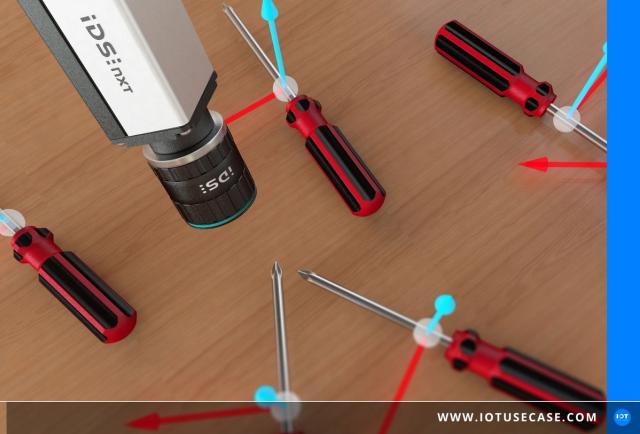









Industrial pick and place robot with AI camera: sort parts
In the solution example from IDS and urobots, the neural network runs directly on the IDS NXT industrial camera: an FPGA with its own AI core executes it with hardware acceleration, so no separate industrial PC is needed. Training takes place in the IDS NXT lighthouse cloud software or with custom TensorFlow models; 10 to 20 images per object were sufficient. A VisionApp converts 2D image coordinates into 3D coordinates and controls the robot via Ethernet. According to urobots, the application detects objects in 200 milliseconds with a positional accuracy of ±2 degrees.
The use cases are quality control, object detection in the material flow and knowledge retention. In the final inspection of sealing rings lying randomly on a belt, the camera identifies defective rings and the robot sorts them out; a product expert's knowledge is passed on to the AI through labelled images. Podcast episode #48 with IDS and urobots explores the approach in depth. Fabmatics, which builds handling systems and transport robots for the semiconductor industry, organises commissioning with the EquipmentCloud from Kontron AIS and has cut the time required by 50 percent.
Podcast episodes featuring Handling robot
Industrial pick and place robots: frequently asked questions
How does the camera of a handling robot detect the position of parts?
A neural network determines the position and orientation of each part in the camera image, which is turned into gripping commands for the robot. In the urobots solution, the AI runs directly on the FPGA of the IDS NXT camera. The software converts 2D image coordinates into 3D coordinates for the robot. According to urobots, it captures the positions of all objects in around 200 milliseconds, which means five captures per second.
Does a handling robot with an AI camera require programming skills?
Not for training the AI: customers upload suitable images to the IDS NXT lighthouse cloud software, label them and start training at the push of a button. A VisionApp from urobots controls the robot; its software is written in Python, while the camera app uses C++. Because the neural network runs directly on the camera, the PC that would otherwise be required is no longer needed. Thanks to Ethernet, the app can be adapted to other robot models.
How does a robotic sorting system learn to tell good parts from bad ones?
With a small number of labelled images and the knowledge of a subject expert. For inspecting sealing rings, 10 to 20 images per object were sufficient. An expert able to judge product defects sorted the images into good and defective. urobots trained the network, converted it to the IDS NXT format and uploaded it to the camera. The software then turns detections into work instructions that the robot uses to sort out defective rings.
How can robot commissioning for handling systems be accelerated?
With a digital service portal that brings together workflows, checklists and equipment history. Instead of Excel spreadsheets, Fabmatics uses the EquipmentCloud from Kontron AIS. The Workflows app guides technicians through tasks such as the precise calibration of cameras. Fabmatics reduced the time needed for commissioning by 50 percent and increased overall process speed by 30 percent; on average, transport robots now need only one acceptance test.
More assets in “Conveying and Handling Technology”

Automated guided vehicle (AGV)
An AGV system brings material automatically from the warehouse to the line when a central fleet controller coordinates the automated guided vehicles (AGV). With IoT, sensors trigger transport orders and vehicles from different manufacturers run in one system.

Crane
Predictive crane maintenance with IoT focuses on the cable carrier, which guides power and data cables to the trolley. Sensors report overload or breakage before the crane comes to a standstill and give maintenance and replacement recommendations.

Industrial robot
Predictive robot maintenance with IoT brings the condition and performance data of industrial robots together on one platform. Operators detect faults and wear before a robot comes to a standstill, and manufacturers identify maintenance cases remotely.

Conveyor belt
Conveyor belt maintenance with IoT relies on sensors that capture vibration, temperature and the condition of the belt and belt cleaners. Operators detect damage such as a torn belt early, plan maintenance as needed and avoid costly line stoppages.
Forklift truck
Forklift tracking with IoT shows where every forklift truck is, which pallet it carries and where that pallet belongs. RFID, UWB and cameras replace manual scanning and document putaway, retrieval and loading automatically.

High-bay warehouse
In a high-bay warehouse, IoT links storage locations, forklifts and warehouse management through real-time data. Staff see on large screens which orders are due next, and pallets are put away and retrieved without manual scanning.
IIoT Use Case user group
What no project tells you
What did the project cost? Which sensor didn't survive in the field? How did you get maintenance on board? 300+ industrial users discuss questions like these with each other every month, openly and without vendors in the room.
Frequent topics in these projects, bring your questions:
- Condition Monitoring
- Digital Documentation
- Quality Management
Online every month
Alternating tech and business focus
Users only
No sales pitches, exchange under NDA
300+ members
OT, IT and IIoT leads from industry