Forming tool
Sensors on the forming tool, or forming die, and on the press record tilt, forces, temperature and vibration at every stroke. Operators detect incorrectly mounted tools and faulty loads before the press, tool or part is damaged.
Forming tool at a glance
Most frequent in the projects on this page
Industries
Users in these projects

Verified projects featuring Forming tool
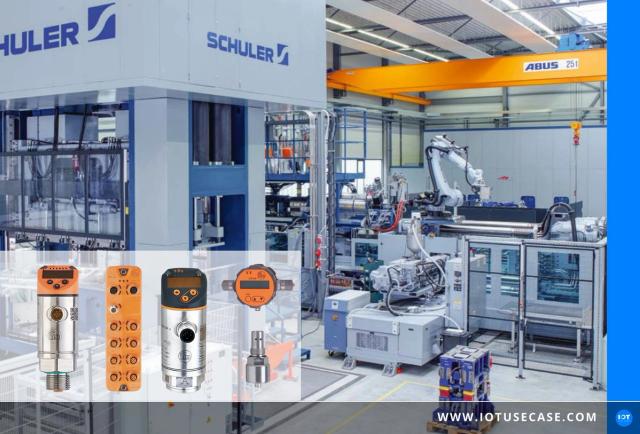











Forming die and press: check every stroke with sensors
The ifm SmartStamp software detects tilt, eccentricity and tilting moment on forming presses within milliseconds. Four high-precision displacement sensors are retrofitted to the press columns for this, supplemented by data from existing force sensors and the tool number and stroke count read from the control. SmartStamp is integrated into the ifm moneo IIoT platform, which raises alarms when limits are exceeded. Balluff retrofitted the machines of a manufacturer of stamped and bent parts with condition monitoring sensors for vibration and temperature. The data travels via IO-Link to the IT level; if a tool's temperature rises above the normal range, the system issues a warning.
The examples come from the automotive industry. Automotive Center Südwestfalen in Attendorn equipped its 1,000-tonne servo press with additional sensors and SmartStamp in 2023. In prototype tests, it analyses the pressing process and the behaviour of material and tool after every stroke and reuses the data in virtual simulation. If limits are exceeded, it can stop the press in real time and prevent damage to press and tool. The supplier supported by Balluff detects process deviations early and avoids quality problems and machine downtime. In podcast episode #26, Melanie Mezger and Adrian Trabold of Balluff report on the project.
Podcast episodes featuring Forming tool
Forming dies: frequently asked questions
How is a servo press monitored with sensors?
A servo press is monitored with displacement sensors, existing force sensors and control data, which software evaluates stroke by stroke. Automotive Center Südwestfalen equipped its servo press with additional sensors and ifm SmartStamp in 2023. Because it mostly runs prototype trials with few strokes, the part and the pressing process are assessed after every stroke. Via moneo, every workstation has access to the press's process and condition data.
Why is the press tilting moment critical for the forming die?
An excessive tilting moment puts undue load on the press guides and damages them over time. According to ifm, bearing damage, gearbox damage or cracks in the press crown can also result. Causes include the design or misalignment during a tool change, which leads to off-centre loading. SmartStamp detects tilt and eccentricity within milliseconds and alerts the operator as soon as the press moves outside its target ranges.
How can an incorrectly mounted tool be detected after a die change?
With stroke monitoring, the operator can detect an incorrectly mounted tool as early as the first stroke cycle. ifm SmartStamp processes the displacement sensors on the four press columns, the force sensors and the tool number and stroke count from the control. The software shows whether the tool is mounted correctly or needs adjusting. Otherwise, misalignment during a die change would increase off-centre loading and thus the tilting moment.
How does real press data feed into forming simulation?
Real press data feeds into forming simulation when every stroke is recorded with forces and kinematics and then reused in the virtual simulation. Automotive Center Südwestfalen uses ifm SmartStamp on its servo press for this. This brings the real process and IT-based simulation closer together. In future, the acs wants to record all process-relevant variables in real time and accompany every product with a digital twin from the start of development.
More assets in “Components & Devices”

Filter
Filter monitoring with IoT measures the differential pressure across a filter and shows how dirty it is. Operators change filters when it is actually necessary, avoid clogged filters and downtime, and save energy and material.

Energy chain
An energy chain with IoT sensors continuously reports the condition of the cable management on moving machinery. Operators learn about overload, blockages or chain breakage before the machine stops, and plan chain replacement according to actual use.

Lighting
Commercial lighting control with IoT adjusts the lighting in offices, halls, shops and advertising installations according to occupancy, brightness and schedules, and monitors every luminaire remotely. Operators cut electricity consumption and learn about failures immediately.

Electricity meter
Automatic meter reading means that electricity meter readings reach a platform via radio, cellular network or pulse adapter, with no on-site reading. Operators bill more accurately and see where energy is consumed in a building or in production.

Charging station
Commercial EV charging relies on load management that distributes the available power across all charging stations at a site and monitors them remotely. Operators avoid overloading the grid connection, integrate photovoltaics and storage, and bill sessions automatically.

Piping network
Pipeline monitoring with IoT reports pressure drops, pressure peaks and moisture under insulation in a piping network before they turn into failures. Operators maintain pipes according to their condition and avoid inspection rounds to hard-to-reach measuring points.
IIoT Use Case user group
What no project tells you
What did the project cost? Which sensor didn't survive in the field? How did you get maintenance on board? 300+ industrial users discuss questions like these with each other every month, openly and without vendors in the room.
Frequent topics in these projects, bring your questions:
- Condition Monitoring
- Quality Management
Online every month
Alternating tech and business focus
Users only
No sales pitches, exchange under NDA
300+ members
OT, IT and IIoT leads from industry