

Emergency call button
Public emergency call points give people a way to call for help when mobile networks, internet or power fail. A dedicated radio network transmits the alarm directly to the fire brigade.
Emergency call button at a glance
Most frequent in the projects on this page
Use cases
Technologies
Users in these projects

Verified projects featuring Emergency call button
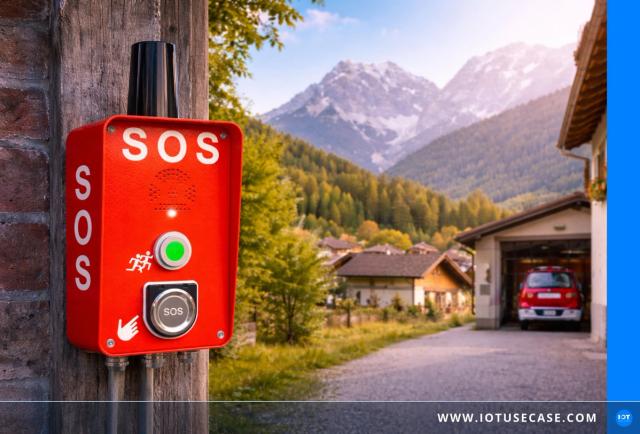







Public emergency call point: alerts without public networks
The solution example uses the m.HELP emergency call button from Swissphone: an IP65 housing, a status LED and a loudspeaker for voice messages. The devices are mains-powered and bridge up to 48 hours of power cuts with a backup battery. The mioty module m.YON transmits to the nearest m.BASE base station, and many call points reach several stations at once. The base stations sit on ridges or towers with emergency power. Data is processed in a locally installed, redundant service and application centre, deliberately without the cloud. Existing alarm servers forward the calls to the regional volunteer fire brigade.
The example comes from the public sector. The Autonomous Province of South Tyrol (Agency for Civil Protection) is installing 333 call points at the fire stations of its municipalities. For 540,000 inhabitants across 7,400 km², 50 base stations are enough. Until now, the paging system only allowed alerts from the control centre to emergency crews, with no return channel from the public. Commissioning is planned for summer 2026. Podcast episode #160 with Diehl Metering and the mioty alliance explains how robust the radio technology is in difficult signal environments.
Podcast episodes featuring Emergency call button
Public emergency call points: frequently asked questions
Does a public emergency call point work during a power cut?
Yes, in the South Tyrol example a backup battery in the call point bridges a power cut of up to 48 hours. The base stations are also located at sites with emergency power. Because the mioty radio protocol needs very little energy, the network can run on backup power for a long time. Processing is local and redundant, so alarms arrive even without the public internet.
How does an alarm from an emergency call point reach the fire brigade?
The alarm travels by radio from the call point to a base station and on to a local service and application centre, which forwards it via existing alarm servers to the responsible volunteer fire brigade. In South Tyrol, the 333 call points are installed at the municipal fire stations. The solution adds a return channel from the public to the existing paging system.
How many base stations does a network of emergency call points need?
It depends on area and terrain, but thanks to long radio range only a few stations are needed even in the mountains. For the whole province of South Tyrol, covering 7,400 km², 50 mioty base stations are planned, and about half were installed by November 2025. They sit on ridges or towers. Many call points reach several base stations at once, which provides redundancy.
Why do municipalities use emergency call points instead of mobile networks?
Call points with their own radio network keep working when mobile networks or the internet fail, for example after storms or large-scale power cuts. In South Tyrol, coverage gaps in valleys and gorges add to the problem. Cellular solutions were ruled out because of their high energy demand, and other LPWAN technologies lacked the required resilience. Swissphone's network is therefore independent of public networks.
More assets in “Components & Devices”

Filter
Filter monitoring with IoT measures the differential pressure across a filter and shows how dirty it is. Operators change filters when it is actually necessary, avoid clogged filters and downtime, and save energy and material.

Energy chain
An energy chain with IoT sensors continuously reports the condition of the cable management on moving machinery. Operators learn about overload, blockages or chain breakage before the machine stops, and plan chain replacement according to actual use.

Lighting
Commercial lighting control with IoT adjusts the lighting in offices, halls, shops and advertising installations according to occupancy, brightness and schedules, and monitors every luminaire remotely. Operators cut electricity consumption and learn about failures immediately.

Electricity meter
Automatic meter reading means that electricity meter readings reach a platform via radio, cellular network or pulse adapter, with no on-site reading. Operators bill more accurately and see where energy is consumed in a building or in production.

Charging station
Commercial EV charging relies on load management that distributes the available power across all charging stations at a site and monitors them remotely. Operators avoid overloading the grid connection, integrate photovoltaics and storage, and bill sessions automatically.

Piping network
Pipeline monitoring with IoT reports pressure drops, pressure peaks and moisture under insulation in a piping network before they turn into failures. Operators maintain pipes according to their condition and avoid inspection rounds to hard-to-reach measuring points.
IIoT Use Case user group
What no project tells you
What did the project cost? Which sensor didn't survive in the field? How did you get maintenance on board? 300+ industrial users discuss questions like these with each other every month, openly and without vendors in the room.
Frequent topics in these projects, bring your questions:
- Employee Safety
Online every month
Alternating tech and business focus
Users only
No sales pitches, exchange under NDA
300+ members
OT, IT and IIoT leads from industry
