Drive chain
A sensor on an industrial roller chain or another drive chain measures elongation, load and temperature during operation. Operators can see how wear is progressing and replace the chain in good time instead of waiting for it to fail.
Drive chain at a glance
Most frequent in the projects on this page
Use cases
Users in these projects


Verified projects featuring Drive chain







Industrial roller chain monitoring: measure wear, plan replacement
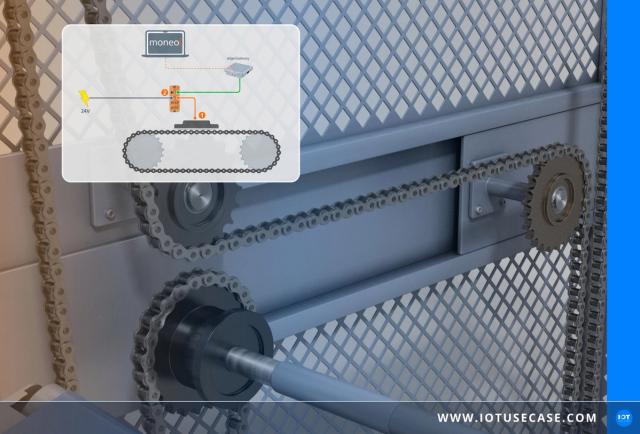
In the ifm example, the IWIS chain sensor CCM-S-10B sits directly on the roller chain and is connected to an IO-Link master. It supplies the position of the most elongated chain link, the total length, running time, speed, acceleration and temperature. The IIoT platform moneo visualises the values, monitors limits and passes the data to third-party systems via MQTT or OPC UA. Through the SFI interface, it automatically triggers maintenance orders and spare parts orders in SAP. On RUD chain conveyors, Telekom IIoT devices record mechanical and thermal load as well as conveying speed and send the data via GSM to the Cloud of Things backend.
The examples come from mechanical engineering, logistics and raw materials. RUD Ketten uses the solution on conveyor systems in coal-fired power plants that remove ash. If ash removal fails, the power plant stops. In the past, the timing of a chain replacement depended on the operator’s instinct. Today, the RUD Cockpit shows operating time, load and chain wear, and maintenance intervals can be controlled much better. Plants in Brazil are already connected. The ifm example shows step by step how roller chain monitoring can be built from standard components.
Industrial roller chain monitoring: frequently asked questions
How is chain wear measured on conveyors such as a drag chain conveyor?
Chain wear can be measured with a sensor that sits directly on the chain and continuously records its elongation. In the ifm example, the IWIS chain sensor compares the total elongation with the maximum elongation of a single chain link. moneo records the values and shows how wear increases over time. If limits are exceeded, the system automatically issues warnings or alarms.
Which values reveal elongation in an industrial chain drive?
The key is comparing the total length of the chain with its longest individual link. The sensor in the ifm solution supplies the position of the link with the greatest elongation, the total length, the running time and the number of links that have passed since start-up. It adds the current running speed, average acceleration and temperature. Historical data shows how these values develop over time.
How does IoT help with conveyor chain maintenance?
IoT makes conveyor chain wear predictable and shows when the chain needs replacing. RUD Ketten developed a solution with Deutsche Telekom for conveyor systems in coal-fired power plants: sensors record load and conveying speed, and the data is sent to the cloud via GSM. In the RUD Cockpit, customers see operating time, load and chain wear, and alarms flag unusual behaviour patterns in real time.
When is the right time for a conveyor chain replacement?
The right time follows from measured wear, not from instinct or fixed intervals. At RUD Ketten, maintenance used to come too late in many cases; today, long-term analyses in the RUD Cockpit show chain wear. In the ifm solution, ticket processing rules in moneo define what happens after a warning, and the SFI interface automatically creates maintenance orders and spare parts orders in SAP.
More assets in “Components & Devices”

Filter
Filter monitoring with IoT measures the differential pressure across a filter and shows how dirty it is. Operators change filters when it is actually necessary, avoid clogged filters and downtime, and save energy and material.
Energy chain
An energy chain with IoT sensors continuously reports the condition of the cable management on moving machinery. Operators learn about overload, blockages or chain breakage before the machine stops, and plan chain replacement according to actual use.

Lighting
Commercial lighting control with IoT adjusts the lighting in offices, halls, shops and advertising installations according to occupancy, brightness and schedules, and monitors every luminaire remotely. Operators cut electricity consumption and learn about failures immediately.

Electricity meter
Automatic meter reading means that electricity meter readings reach a platform via radio, cellular network or pulse adapter, with no on-site reading. Operators bill more accurately and see where energy is consumed in a building or in production.

Charging station
Commercial EV charging relies on load management that distributes the available power across all charging stations at a site and monitors them remotely. Operators avoid overloading the grid connection, integrate photovoltaics and storage, and bill sessions automatically.

Piping network
Pipeline monitoring with IoT reports pressure drops, pressure peaks and moisture under insulation in a piping network before they turn into failures. Operators maintain pipes according to their condition and avoid inspection rounds to hard-to-reach measuring points.
IIoT Use Case user group
What no project tells you
What did the project cost? Which sensor didn't survive in the field? How did you get maintenance on board? 300+ industrial users discuss questions like these with each other every month, openly and without vendors in the room.
Frequent topics in these projects, bring your questions:
- Condition Monitoring
Online every month
Alternating tech and business focus
Users only
No sales pitches, exchange under NDA
300+ members
OT, IT and IIoT leads from industry