Chain conveyor
Chain conveyor maintenance in power plants relies on IoT sensors that record heavy thermal and mechanical load during ash removal continuously, so operators can plan chain replacement before the conveyor fails and the plant stops.
Chain conveyor at a glance
Most frequent in the projects on this page
Use cases
Industries
Users in these projects

Verified projects featuring Chain conveyor
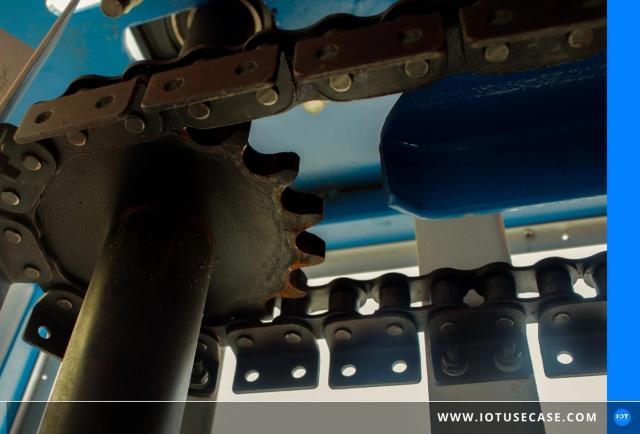



Chain conveyor maintenance with IoT sensors
In the solution example, Deutsche Telekom equips the conveyor systems with IIoT devices. Their sensors measure mechanical and thermal load as well as conveying speed. Built-in SIM cards transmit the data in encrypted form via GSM to Telekom's Cloud of Things backend. In the RUD Cockpit, the customer sees all plant data and can set up alarms. Widgets produce long-term analyses and status reports on operating time, current and average load and chain wear, based on RUD's engineering knowledge.
The user is RUD Ketten Rieger & Dietz GmbH & Co. KG, a specialist in conveyor and drive technology. Its chain systems handle ash removal in coal-fired power plants. Previously, only a traffic-light system on the plant indicated its condition, and scheduled maintenance often came too late. Deflection pulleys, round steel chains and chain locks then had to be replaced at short notice. Together with Telekom, a prototype was built in three months and a ready-to-use solution after six more months. Since then, maintenance intervals have been managed better, RUD offers data analysis as an additional business model, and plants in Brazil are already connected.
Chain conveyors: frequently asked questions
Why is the ash conveyor so critical in a power plant?
If the ash conveyor fails, the power plant comes to a standstill. The conveyor carries the weight of the ash, heat and continuous operation, and these loads are not uniform. As a result, chain service life varies. At RUD, the right time for a precautionary chain replacement used to be hard to estimate, and unplanned downtime was expensive for power plant operators.
What data does chain conveyor monitoring provide?
Monitoring provides readings on mechanical and thermal load and on conveying speed. In the RUD and Deutsche Telekom example, the data travels via GSM to the Cloud of Things and appears in the RUD Cockpit. Widgets evaluate it for operating time, current and average load and chain wear. Alarms flag conspicuous behaviour patterns in real time.
How does chain wear monitoring work on a conveyor?
Chain wear can be calculated from continuously measured load data instead of being checked only during maintenance. RUD transferred its engineering knowledge into widgets on the Telekom platform for this purpose. They produce long-term analyses and status reports that make wear and chain service life more predictable. Previously, only a traffic light on the plant showed its condition, and often the red light was already on.
How much effort does it take to connect an ash handling system?
At RUD, it took three months from the start to a prototype, and the solution was ready for use after six more months. Telekom fitted the conveyor systems with IIoT devices whose sensors send their data via built-in SIM cards over GSM. Because the data is in the cloud, RUD can also connect plants internationally. Plants in Brazil are already connected.
More assets in “Conveying and Handling Technology”

Automated guided vehicle (AGV)
An AGV system brings material automatically from the warehouse to the line when a central fleet controller coordinates the automated guided vehicles (AGV). With IoT, sensors trigger transport orders and vehicles from different manufacturers run in one system.

Crane
Predictive crane maintenance with IoT focuses on the cable carrier, which guides power and data cables to the trolley. Sensors report overload or breakage before the crane comes to a standstill and give maintenance and replacement recommendations.

Industrial robot
Predictive robot maintenance with IoT brings the condition and performance data of industrial robots together on one platform. Operators detect faults and wear before a robot comes to a standstill, and manufacturers identify maintenance cases remotely.

Conveyor belt
Conveyor belt maintenance with IoT relies on sensors that capture vibration, temperature and the condition of the belt and belt cleaners. Operators detect damage such as a torn belt early, plan maintenance as needed and avoid costly line stoppages.
Forklift truck
Forklift tracking with IoT shows where every forklift truck is, which pallet it carries and where that pallet belongs. RFID, UWB and cameras replace manual scanning and document putaway, retrieval and loading automatically.

High-bay warehouse
In a high-bay warehouse, IoT links storage locations, forklifts and warehouse management through real-time data. Staff see on large screens which orders are due next, and pallets are put away and retrieved without manual scanning.
IIoT Use Case user group
What no project tells you
What did the project cost? Which sensor didn't survive in the field? How did you get maintenance on board? 300+ industrial users discuss questions like these with each other every month, openly and without vendors in the room.
Frequent topics in these projects, bring your questions:
- Condition Monitoring
Online every month
Alternating tech and business focus
Users only
No sales pitches, exchange under NDA
300+ members
OT, IT and IIoT leads from industry