Welding system
Welding monitoring uses connected sensors on a welding system to record temperature, voltage, current and power at connectors and cables. Maintenance teams find faults faster, even in hard-to-reach places, and operators see how welding equipment is actually used.
Welding system at a glance
Most frequent in the projects on this page
Verified projects featuring Welding system
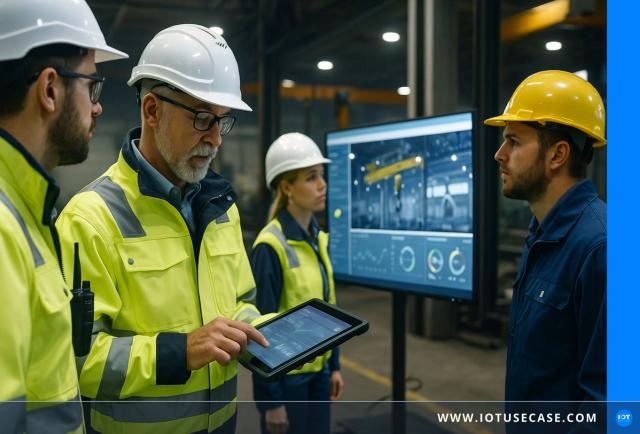



Scalable HSE (Health Safety Environment) – through central IoT monitoring instead of additional personnel



Networked connectors for efficient troubleshooting
Welding monitoring: find faults and make usage transparent
IMS Connector Systems’ SmartMod connectors look like 4-pin M12 circular connectors but contain sensors for temperature, voltage, current and power. An integrated chip transmits the readings via Bluetooth Low Energy to a smartphone or tablet, or to gateways that integrate them into the existing control system via ProfiNet, Modbus or Ethernet. The data is also sent to the IMS cloud via cellular network. The connectors can be retrofitted and require no new wiring. For predictive maintenance, AI-Omatic’s digital maintenance assistant uses machine learning to learn normal operation and detect deviations.
The examples come from mechanical engineering and oil and gas plant construction. A typical coil welding line stretches over 120 metres, with many enclosures full of electrical components. There, the connected connectors show whether a fault lies in the connector itself or in the cable harness. An industrial technology company from the Middle East introduced 44 health and safety applications on the Cumulocity platform during the construction of offshore oil and gas facilities. One of the use cases it developed uses sensors to record the actual usage of welding equipment and assign it to specific teams.
Welding monitoring: frequently asked questions
What data does monitoring a welding system provide?
In the solution examples, monitoring a welding system provides condition data on the electrical system and usage data on the equipment. IMS Connector Systems’ SmartMod connectors measure temperature, voltage, current and power directly at the connection and detect kinked cables, damage or a missing power supply. During the construction of offshore oil and gas facilities, sensors also record the actual usage of welding equipment and assign it to teams.
How can faults be found faster on a long welding line?
Connected connectors show whether a fault lies in the connector itself or in the cable harness between two end points. A typical coil welding line stretches over 120 metres, with many enclosures full of electrical components, so manual troubleshooting is very time-consuming. The SmartMod connectors can be retrofitted and need no new wiring. Broken cables or torn-off connectors are detected immediately, and maintenance technicians complete their diagnosis faster.
How can a coil welding line be protected against unplanned downtime?
A coil welding line can be protected with predictive maintenance that detects faults before they lead to downtime. IMS Connector Systems combines its smart connectors with AI-Omatic’s digital maintenance assistant, which monitors machines automatically and unattended. Using machine learning, the system captures normal operation and recognises from minimal deviations when a fault is developing. According to the provider, only a brief data alignment is needed beforehand.
How does fleet management for welding equipment work?
Fleet management for welding equipment uses sensors to record when and by whom each device is actually used. An industrial technology company from the Middle East has developed such a use case on the Cumulocity platform: the data is assigned to specific teams, and customers get an overview of usage patterns. The company expects this to improve how machines are distributed and allocated and to reduce waste.
More assets in “Machinery and Equipment”

Pump
Pump monitoring with IoT records vibration, temperature, pressure and energy consumption of running pumps. Operators detect damage and faults before a pump fails and plan maintenance by condition rather than at fixed intervals.

Compressor
With IoT, compressor maintenance follows actual condition: sensors record current consumption, pressure, temperature and running times. Operators detect creeping damage and unused running time early and cut energy and service costs.

Electric motor
Motor condition monitoring with IoT continuously measures the vibration, temperature and current draw of electric motors. Operators detect imbalance, bearing damage or winding faults early and replace motors based on condition rather than after a failure.

Packaging machine
OEE software automatically records run times, downtime, speed and rejects on packaging machines from the machine signals. Operators see where their lines lose performance, and machine builders use the same data for remote access and digital services.

Refrigeration system
A refrigeration monitoring system makes service plannable: temperatures, refrigerant circuit pressures, compressor status and energy consumption flow into a platform in real time. Operators and service partners detect faults early, avoid unnecessary site visits and reduce excess consumption.

Air conditioning system
Commercial air conditioning systems in offices, retail branches and data centres can be monitored remotely with IoT. Operators see energy consumption, temperatures and faults in one place, detect failing compressors or refrigerant shortages early and plan service visits precisely.
IIoT Use Case user group
What no project tells you
What did the project cost? Which sensor didn't survive in the field? How did you get maintenance on board? 300+ industrial users discuss questions like these with each other every month, openly and without vendors in the room.
Frequent topics in these projects, bring your questions:
- Condition Monitoring
- Corrective maintenance
- Employee Safety
Online every month
Alternating tech and business focus
Users only
No sales pitches, exchange under NDA
300+ members
OT, IT and IIoT leads from industry