Returnable container
IoT for returnable packaging records where returnable containers are and whether they are empty or full. Production and logistics trigger replenishment and transport orders automatically, save inspection rounds and avoid shortages and unnecessary trips.
Returnable container at a glance
Most frequent in the projects on this page
Verified projects featuring Returnable container
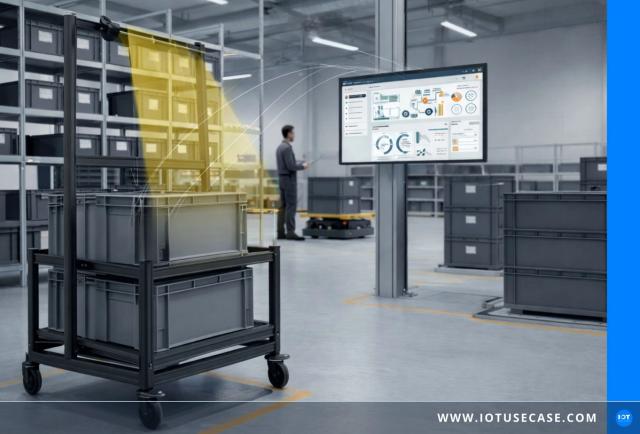










Returnable packaging: control empty containers by demand
ORGATEX uses the OX location sensor and the OX Kanban sensor, which measure position and fill level contactlessly with optical time-of-flight technology. The location sensor detects whether a container is present, empty or full and triggers a replenishment order when needed. The data goes to the ORGATEX Cloud in real time, hosted on AWS servers in Frankfurt. Transmission runs via the Thread mesh network or via NB-IoT and LTE-M. The OX Label with an e-paper display shows status information on the container, confirms transport orders and is connected to ERP and MES systems. The OX Button from ORGATEX and IOX reorders material at the push of a button.
The examples come from mechanical engineering and logistics. At a machine builder, one of the first users, a milk run takes around 45 minutes on average. With real-time data on locations and fill levels, empties are now moved according to demand, milk runs are more targeted and inspection rounds are no longer needed. At one customer of ORGATEX and IOX, digital container labels replace up to 90 pages of paper per order. Podcast episode #150 explores the IoT button and digital container labelling in more depth.
Podcast episodes featuring Returnable container
Returnable packaging: frequently asked questions
How can a plant keep track of its reusable transport packaging?
Sensors at storage locations and on shelves continuously record where empty and full containers are and send the data to the cloud in real time. In many plants, the status of empties is not consistently visible because empty containers often have no goods value in the ERP system. At the machine builder, the ORGATEX solution creates this transparency: empties are moved according to demand, milk runs are more targeted and manual inspection rounds are no longer needed.
How do digital returnable container labels replace paper?
E-paper displays on the container show stock levels or production orders in real time and replace paper labels. The OX Label from ORGATEX and IOX is managed centrally in a back end, and new information is loaded onto the display at the push of a button. Transmission runs via NB-IoT and LTE Cat-M1, which remain stable even in halls with a lot of metal. At one customer, this saves up to 90 pages of paper per order.
How does returnable container management detect empty and full containers?
Sensors at the storage location detect whether a container is present, empty or full and automatically trigger orders. The ORGATEX OX location sensor uses optical time-of-flight technology for this. If material is missing, a replenishment order is created; if empty containers accumulate, a transport order follows. In the ORGATEX Cloud, staff configure these processes without programming skills and define alarms.
How is data on returnable plastic containers linked to ERP and MES?
Via standardised interfaces that exchange data in both directions. The ORGATEX Cloud manages all devices and provides APIs to ERP, MES and logistics systems. For the solutions developed with IOX, integration runs via REST APIs or no-code tools. The devices install updates automatically over the air, without IT intervention or interrupting production.
More assets in “Containers, Silos and Tanks”

Transport container
Shipment monitoring with IoT reports where a transport container is and whether anyone opens it without authorisation. For valuable or sensitive goods, the system raises an alarm immediately instead of a theft only being noticed by the recipient.

Load carrier
An RTLS locates load carriers such as mesh boxes, pallets and bins across halls and plants in real time. Companies cut search times, replace accompanying paperwork and manual scanning, and trigger bookings and transports automatically.

Pallet
Pallet tracking with IoT shows where every pallet is, what is on it and how much stock remains. Sensors, RFID and wireless networks replace search trips, manual scanning and stocktaking counts with a forklift.

Process vessel
Process monitoring with IoT continuously records level, temperature, humidity and other parameters in a process vessel. Without inspection rounds, operators know when to refill or empty it and whether the contents are still usable.

Collection container
Waste container monitoring connects collection containers and waste locks so that they report fill levels and emptying events in real time. Operators see which containers are full, plan collections accordingly and bill by actual use.
Container
Container tracking software with IoT shows where a container is and its status, whether an air freight container, a container in a construction fleet or a unit shipped worldwide. Companies save search time and plan storage more precisely.
IIoT Use Case user group
What no project tells you
What did the project cost? Which sensor didn't survive in the field? How did you get maintenance on board? 300+ industrial users discuss questions like these with each other every month, openly and without vendors in the room.
Frequent topics in these projects, bring your questions:
- Asset Management
- Asset Tracking/ Track and Trace
- Digital Documentation
Online every month
Alternating tech and business focus
Users only
No sales pitches, exchange under NDA
300+ members
OT, IT and IIoT leads from industry