Mesh pallet box
A mesh stillage collects industrial waste that has to be picked up at the right time. IoT sensors measure fill level and weight so that the disposal company arrives neither too early nor too late.
Mesh pallet box at a glance
Most frequent in the projects on this page
Technologies
Users in these projects

Verified projects featuring Mesh pallet box
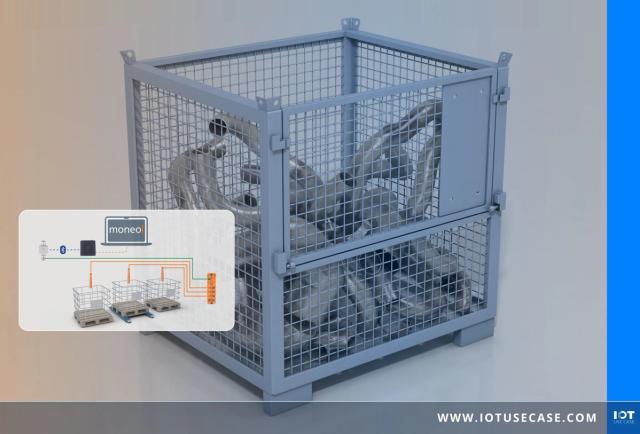




Mesh stillage with IoT: fill level and weight
In the solution example, an ultrasonic sensor monitors the fill level as a process value from 0 to 100 per cent. For the weight, the mesh stillage stands on a pallet scale with four strain gauge sensors connected in parallel. A strain gauge amplifier outputs 4 to 20 mA, corresponding to 0 to 600 kg. Both signals go to the AL2301 IO-Link module and from there via Bluetooth Mesh adapters wirelessly to the moneo Bluetooth Base, which handles up to 50 adapters. The IIoT platform moneo evaluates and visualises the values. When a container is full, moneo automatically creates a ticket, sends an email and orders an empty container.
User and provider is the ifm group of companies, with fill level measurement and container management as use cases. In practice, fill level alone was not enough. Metal scrap piles up in a cone, at 100 per cent in the middle and around 50 per cent at the sides. This led to premature emptying. Conversely, a stillage can still show green on the fill level and yet be too heavy to move, so staff have to reload it. Combined measurement of fill level and weight shows the actual disposal need, with no long cable runs.
Mesh stillage: frequently asked questions
How is the fill level of a mesh stillage monitored?
An ultrasonic sensor continuously measures the fill level of the mesh stillage and passes it to the ifm IIoT platform moneo as a process value from 0 to 100 per cent. When the container is full, moneo automatically creates a ticket, emails the staff responsible and orders an empty container. After the swap the ticket is closed, so the process remains fully digital.
How is a mesh stillage weighed automatically?
With a pallet scale underneath the stillage. In the ifm example, it consists of four strain gauge sensors connected in parallel. A matching strain gauge amplifier supplies a current signal from 4 mA with the scale empty to 20 mA at a full load of 600 kg. The scale is connected to free ports on the AL2301 IO-Link module, to which the fill level sensors are already attached.
When should a mesh stillage be collected?
When fill level or weight shows the actual need, not according to a fixed schedule. If the disposal company comes too early, costs are wasted; if it comes too late, the container overflows. At ifm it turned out that fill level alone triggers too early with metal scrap, because it piles up in a cone. Only the combination with weight provides a reliable basis for decisions.
How are sensors on a mesh stillage connected without cables?
Via Bluetooth Mesh adapters that send the sensor signals wirelessly to a base station. At ifm, they transmit fill level and weight to the moneo Bluetooth Base, which integrates up to 50 adapters. From there the data reaches the IIoT platform moneo. This removes the wiring effort that otherwise makes monitoring expensive where cable runs are long.
More assets in “Containers, Silos and Tanks”

Transport container
Shipment monitoring with IoT reports where a transport container is and whether anyone opens it without authorisation. For valuable or sensitive goods, the system raises an alarm immediately instead of a theft only being noticed by the recipient.

Load carrier
An RTLS locates load carriers such as mesh boxes, pallets and bins across halls and plants in real time. Companies cut search times, replace accompanying paperwork and manual scanning, and trigger bookings and transports automatically.

Pallet
Pallet tracking with IoT shows where every pallet is, what is on it and how much stock remains. Sensors, RFID and wireless networks replace search trips, manual scanning and stocktaking counts with a forklift.

Process vessel
Process monitoring with IoT continuously records level, temperature, humidity and other parameters in a process vessel. Without inspection rounds, operators know when to refill or empty it and whether the contents are still usable.

Collection container
Waste container monitoring connects collection containers and waste locks so that they report fill levels and emptying events in real time. Operators see which containers are full, plan collections accordingly and bill by actual use.
Container
Container tracking software with IoT shows where a container is and its status, whether an air freight container, a container in a construction fleet or a unit shipped worldwide. Companies save search time and plan storage more precisely.
IIoT Use Case user group
What no project tells you
What did the project cost? Which sensor didn't survive in the field? How did you get maintenance on board? 300+ industrial users discuss questions like these with each other every month, openly and without vendors in the room.
Frequent topics in these projects, bring your questions:
- Asset Management
- Condition Monitoring
Online every month
Alternating tech and business focus
Users only
No sales pitches, exchange under NDA
300+ members
OT, IT and IIoT leads from industry