Liquid in IBC
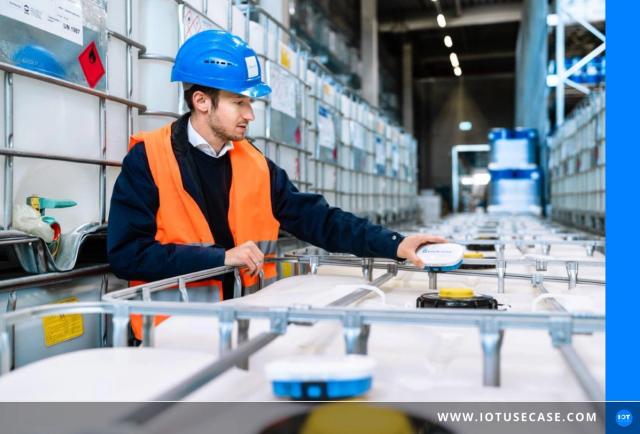
IBC tracking with IoT shows the level, location, temperature and movement of every IBC and the liquid inside it. Companies make better use of their container fleet, plan reorders and keep an eye on the content even in transit.
Liquid in IBC at a glance
Most frequent in the projects on this page
Industries
Users in these projects

Verified projects featuring Liquid in IBC


IBC tracking: level, location and condition of every container
In the solution example, every IBC, including older ones, is fitted with the Packwise Smart Cap sensor box, which is retrofitted with an adhesive film. It measures the fill level to within 5 to 10 litres, locates the container indoors and outdoors to within 3 metres, detects tilting and strong acceleration, reports movements and records the ambient temperature. The data travels via a 1NCE SIM, preferably over NB-IoT or LTE-M, into the Packwise Flow web application, which holds a digital twin of each container.
The user is Dresden-based Packwise, which digitalises IBCs for reconditioning and reuse, with 1NCE as partner. Customers from the food and chemical industries see the key data of individual containers and whole groups in Packwise Flow, share stock levels, temperature histories and arrival times with their own customers and trigger orders in their ERP systems via interfaces. According to the source, this above all reduces the idle time of IBCs. In podcast episode #221, the hosts also discuss the business case of a monitored heating chamber at DENIOS in which IBC batches are kept at temperature.
Podcast episodes featuring Liquid in IBC
IBC tracking: frequently asked questions
How accurately does an IoT sensor measure the level in an IBC?
The Packwise Smart Cap measures the level in an IBC to within 5 to 10 litres. The sensor box is attached to the outside of the container and sends the value together with location, temperature and movement data to Packwise Flow. There, users see the content of each container and can automatically trigger an order in their ERP system via an interface when the level is low.
What data does an IBC tote tracker provide during transport?
During transport, an IBC tote tracker provides location, level, temperature, movement and position of the container. The Packwise Smart Cap also detects whether the IBC is tilted or exposed to strong acceleration and reports critical temperatures. Movements are transmitted at defined intervals. The connection runs over a 1NCE SIM, which works in warehouses as well as outdoors.
Why is tracking worthwhile for IBC reconditioning and reuse?
Tracking pays off because IBCs are expensive and may legally be used for only five years. After that, they are disposed of or, if they did not carry hazardous substances, reconditioned and sold. Knowing exactly where each container is and how full it is during that time means moving the same volumes with fewer containers, planning routes better and losing fewer IBCs to theft or damage.
How precise is IBC location tracking?
The Packwise Smart Cap locates an IBC indoors and outdoors to within 3 metres. It sends its position via a 1NCE SIM that uses the best available radio technology, preferably NB-IoT or LTE-M. According to the source, both networks are energy-efficient and allow battery lifetimes of several years. In Packwise Flow, users see the location of individual containers and entire container groups.
More assets in “Fluids & Gases”

Compressed air
Compressed air leak detection with IoT continuously measures flow, pressure and compressor load, revealing leaks and unused running times. This cuts the cost of one of the most expensive forms of energy in manufacturing.

Indoor air
Indoor air quality monitoring with IoT means sensors continuously record CO₂, fine dust, particles, temperature and humidity and report limit violations immediately. Operators protect employees, safeguard product quality and heat and ventilate according to demand.

Drinking water
Water network leak detection for drinking water continuously measures pressure, flow and consumption with IoT and reports deviations immediately. Utilities find leaks, pipe bursts and water theft sooner and lose less drinking water.

Groundwater
Groundwater monitoring with IoT measures levels automatically and transmits them by radio to a platform. Authorities, utilities, construction sites and businesses with their own well replace manual measurements and are alerted to critical water levels or pump faults.

Wastewater
Wastewater flow measurement, levels and water quality can be recorded with IoT directly at pipes, basins and discharge points. Operators see wastewater volumes in real time, respond faster to faults and meet reporting obligations without daily sampling.

Molten metal
In foundry melting and vacuum metallurgy, IoT continuously records the melt pool, fill level, temperature and pressure of molten metal. Deviations show up before a batch becomes unusable or a furnace runs empty.
IIoT Use Case user group
What no project tells you
What did the project cost? Which sensor didn't survive in the field? How did you get maintenance on board? 300+ industrial users discuss questions like these with each other every month, openly and without vendors in the room.
Frequent topics in these projects, bring your questions:
- Asset Management
- Asset Tracking/ Track and Trace
- Condition Monitoring
Online every month
Alternating tech and business focus
Users only
No sales pitches, exchange under NDA
300+ members
OT, IT and IIoT leads from industry