Irrigation water
Irrigation water management with IoT records when and how much water actually flows to the fields. The administration compares this with irrigation schedules, saves inspection trips and reduces evaporation losses.
Irrigation water at a glance
Most frequent in the projects on this page
Verified projects featuring Irrigation water



Irrigation water management: use water to plan
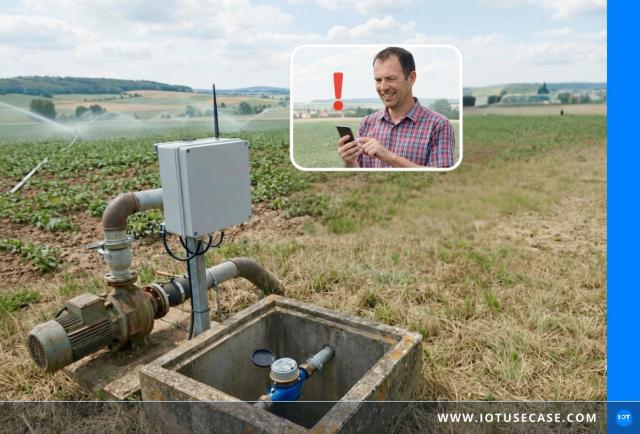
In the solution example, the SMARTebox nanoIO from PSsystec reads the water meters of the irrigation systems. The compact, battery-powered data logger in an IP65 housing is designed for retrofitting distributed and even underground installations. It has four potential-free inputs for meter pulses or alarm contacts and a BLE interface for beacons. Data travels via LTE-M or NB-IoT over Deutsche Telekom's PSA-certified path into the IoT platform; where the signal in a shaft is weak, an external antenna helps. SMS alerts report the start, end and volume of irrigation as well as soil moisture. A REST API connects the operator's system, and configuration is done remotely via a web app.
The example comes from agriculture and the public sector. A district in Germany has used it to digitise agricultural irrigation. Previously, farmers or the administration had to check on site whether irrigation schedules were being followed, and many pumping stations and meters are hard to reach. Today, flow volumes are compared with planned time windows such as 8 to 10 pm. Manual checks are no longer needed, and automatic documentation supports internal analysis and the processing of subsidies.
Irrigation water management: frequently asked questions
How can compliance with agricultural irrigation schedules be checked?
A data logger on the water meter records flow volumes and automatically compares them with the planned time windows. In the district from the example, this is the period from 8 to 10 pm, for instance. The SMARTebox nanoIO reports the start, end and volume of each irrigation run by SMS. Inspection trips by the administration or farmers to the distributed pumping stations and meters are no longer needed.
How does digital control reduce evaporation losses in irrigation?
It ensures that irrigation takes place at favourable times of day rather than in the heat of the day. Without digital control, water was wasted in the example because irrigation took place at unfavourable times. With time-controlled irrigation using the PSsystec solution, the district reduced evaporation and made irrigation more efficient. Water consumption fell significantly.
How can distributed irrigation systems without IT connections be monitored?
With a battery-powered data logger that transmits over the cellular network and connects to existing meters. The SMARTebox nanoIO is compatible with all meters with a pulse output and can be mounted by magnet, on a wall or on a pipe. According to the provider, it runs autonomously for up to five years on five standard batteries. Commissioning and fleet management are handled remotely via a web app.
How does automatic documentation help with irrigation?
It records all irrigation data seamlessly without anyone having to keep lists. In the district from the example, the documentation is used for internal analysis and for processing subsidies. The values are available as charts on the IoT platform and can be transferred into the operator's own systems via the REST API. Manual checks by staff are no longer required.
More assets in “Fluids & Gases”

Compressed air
Compressed air leak detection with IoT continuously measures flow, pressure and compressor load, revealing leaks and unused running times. This cuts the cost of one of the most expensive forms of energy in manufacturing.

Indoor air
Indoor air quality monitoring with IoT means sensors continuously record CO₂, fine dust, particles, temperature and humidity and report limit violations immediately. Operators protect employees, safeguard product quality and heat and ventilate according to demand.

Drinking water
Water network leak detection for drinking water continuously measures pressure, flow and consumption with IoT and reports deviations immediately. Utilities find leaks, pipe bursts and water theft sooner and lose less drinking water.

Groundwater
Groundwater monitoring with IoT measures levels automatically and transmits them by radio to a platform. Authorities, utilities, construction sites and businesses with their own well replace manual measurements and are alerted to critical water levels or pump faults.

Wastewater
Wastewater flow measurement, levels and water quality can be recorded with IoT directly at pipes, basins and discharge points. Operators see wastewater volumes in real time, respond faster to faults and meet reporting obligations without daily sampling.

Molten metal
In foundry melting and vacuum metallurgy, IoT continuously records the melt pool, fill level, temperature and pressure of molten metal. Deviations show up before a batch becomes unusable or a furnace runs empty.
IIoT Use Case user group
What no project tells you
What did the project cost? Which sensor didn't survive in the field? How did you get maintenance on board? 300+ industrial users discuss questions like these with each other every month, openly and without vendors in the room.
Frequent topics in these projects, bring your questions:
- Digital Documentation
- Energy Monitoring
- Fleet Management
Online every month
Alternating tech and business focus
Users only
No sales pitches, exchange under NDA
300+ members
OT, IT and IIoT leads from industry