

Industrial adhesive
In industrial adhesive storage, temperature determines whether the adhesive keeps its bonding properties. IoT sensors monitor refrigerated storage cabinets and report temperature drops or open doors at once, without manual inspection rounds.
Industrial adhesive at a glance
Most frequent in the projects on this page
Industries
Users in these projects

Verified projects featuring Industrial adhesive
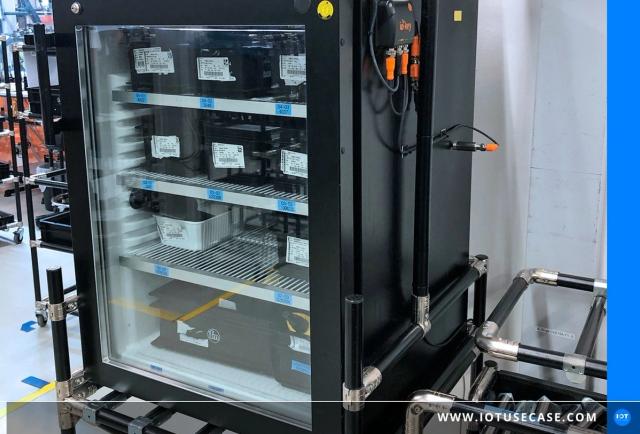



Industrial adhesive storage: monitor temperature and door
In the solution example, each refrigerator is fitted with an ifm io-key IoT gateway. It is connected to an IO-Link temperature sensor and an inductive sensor for the door status. The io-key transmits via 2G or NB-IoT to a secure cloud, where the values appear in real time on a dashboard. The transmission interval can be set from every 10 seconds to once every 24 hours. Alarms for excess temperature or a door left open too long are sent immediately by email or SMS regardless of this setting, and also appear on site as an audible and visual signal. A reporting function makes temperature histories traceable afterwards.
The example comes from metal and electronics. The ifm group, a manufacturer of hardware and software for industrial automation, bonds many temperature-sensitive components instead of soldering them. Its adhesives carry a best-before date and are kept in refrigerators in every production area. Typical problems were doors not closed properly, incorrect settings and compressor faults. Today, staff only need to check when an alarm is raised, and no cabling to the IT infrastructure was required.
Industrial adhesive storage: frequently asked questions
How is the storage temperature of adhesives monitored automatically?
A temperature sensor in the storage refrigerator measures continuously and reports deviations to a cloud via an IoT gateway. In the ifm example, the IO-Link sensor is connected to an io-key that transmits over the cellular network. If the temperature exceeds the limit, an email or SMS is sent immediately, along with a signal on site. A fault is therefore noticed before the adhesive becomes unusable.
Why do industrial adhesives need refrigerated storage?
Many industrial adhesives only keep their bonding properties if stored at the specified temperature. These include acrylic, epoxy, polyurethane and silicone. The manufacturer in the example uses adhesives with specific storage conditions and a best-before date, after which bonding performance is no longer guaranteed. That is why every production area has a refrigerator whose temperature and door are monitored.
What role do adhesives play in electronics manufacturing?
In electronics manufacturing, adhesives often replace soldering because many components are temperature-sensitive and are only plugged in. High cycle rates add to this: applying a dot of adhesive is faster than other fastening methods. Correct storage therefore becomes a prerequisite for quality. The ifm group monitors all adhesive refrigerators in its production areas automatically for this reason.
What are the benefits of automatic temperature monitoring for adhesives?
It replaces regular checks of every refrigerator by staff and reports problems immediately. At ifm, employees only need to check and fix the fault when an alarm is raised. Temperature histories remain available in the reporting function over the long term, for example when investigating quality issues. Because the solution transmits over the cellular network, no connection to the IT infrastructure or cabling was required.
More assets in “Fluids & Gases”

Compressed air
Compressed air leak detection with IoT continuously measures flow, pressure and compressor load, revealing leaks and unused running times. This cuts the cost of one of the most expensive forms of energy in manufacturing.

Indoor air
Indoor air quality monitoring with IoT means sensors continuously record CO₂, fine dust, particles, temperature and humidity and report limit violations immediately. Operators protect employees, safeguard product quality and heat and ventilate according to demand.

Drinking water
Water network leak detection for drinking water continuously measures pressure, flow and consumption with IoT and reports deviations immediately. Utilities find leaks, pipe bursts and water theft sooner and lose less drinking water.

Groundwater
Groundwater monitoring with IoT measures levels automatically and transmits them by radio to a platform. Authorities, utilities, construction sites and businesses with their own well replace manual measurements and are alerted to critical water levels or pump faults.

Wastewater
Wastewater flow measurement, levels and water quality can be recorded with IoT directly at pipes, basins and discharge points. Operators see wastewater volumes in real time, respond faster to faults and meet reporting obligations without daily sampling.

Molten metal
In foundry melting and vacuum metallurgy, IoT continuously records the melt pool, fill level, temperature and pressure of molten metal. Deviations show up before a batch becomes unusable or a furnace runs empty.
IIoT Use Case user group
What no project tells you
What did the project cost? Which sensor didn't survive in the field? How did you get maintenance on board? 300+ industrial users discuss questions like these with each other every month, openly and without vendors in the room.
Frequent topics in these projects, bring your questions:
- Condition Monitoring
- Corrective maintenance
Online every month
Alternating tech and business focus
Users only
No sales pitches, exchange under NDA
300+ members
OT, IT and IIoT leads from industry
