

Drum
Drum level monitoring with IoT continuously shows how much material is left in a drum and calculates its remaining time. Resupply is ordered in good time, and production does not stop because resin or hardener has run out.
Drum at a glance
Most frequent in the projects on this page
Technologies
Users in these projects

Verified projects featuring Drum
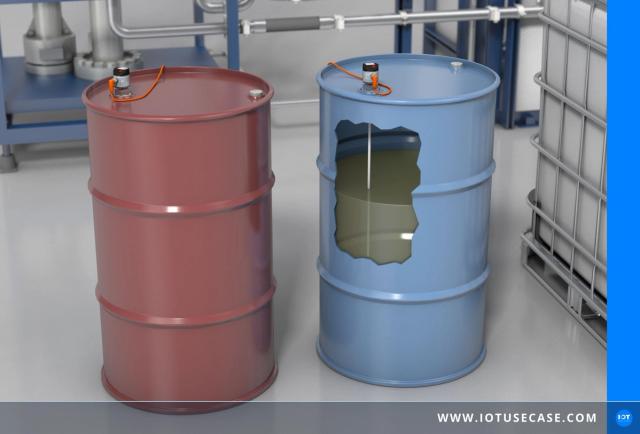



Drum level monitoring: plan resupply before material runs out
In the solution example, level sensors on the drums send their value to the plant controller as a 4–20 mA signal. An IO-Link data splitter (E43406) leaves this signal untouched and additionally extracts the IO-Link signal, which an IO-Link master (AL1350) passes to the ifm moneo IIoT platform. Optical distance sensors detect when the doors in front of the drums are opened, so that changing a drum does not trigger a wrong order. The moneo LifetimeEstimator, a no-code AI tool, predicts the remaining time of each drum.
The example comes from mechanical engineering and electronics: in sensor manufacturing, the ifm group monitors the drums of resin and hardener used for casting resin. Because the two substances are used up at different rates and new drums first have to adjust to the room climate, lead time matters. The warning threshold triggers material procurement in SAP, the alarm threshold marks the drum change. Once trained, the system orders a new drum from the central warehouse 24 hours before the alarm threshold is reached. In podcast episode #113, DENIOS and ROBIOTIC also present a leakage warning system for hazardous materials storage.
Podcast episodes featuring Drum
Drum level monitoring: frequently asked questions
How do you prevent false alarms when changing a drum?
False alarms during a drum change can be prevented if the system recognises that someone is working on the drum. At ifm, optical distance sensors detect when the doors in front of the casting resin drums are opened. During this time, a falling or jumping level does not trigger an order. This avoids wrong orders caused by an unintentionally reached threshold, whether during a change or during maintenance.
How is reordering automated in chemical drum storage?
Reordering is automated by letting level thresholds trigger an order directly. In the ifm example, moneo sends an order to SAP via its own interface when the warning threshold is reached. Later, the moneo LifetimeEstimator takes over: it calculates the remaining time from actual consumption and orders a new drum from the central warehouse 24 hours before the change is due.
Can existing drum level sensors be connected without touching the controller?
Yes, existing sensors can be connected without any change to the controller. ifm uses an IO-Link data splitter for this: it passes the 4–20 mA signal unchanged to the plant controller and makes the previously unused IO-Link signal available to an IO-Link master. The adapter galvanically isolates both sides, so the original controller is not affected. The data travels over the network to moneo.
How does IoT support monitoring in hazardous material storage?
In hazardous material storage, IoT monitors values such as temperature and leaks automatically and replaces manual inspection rounds. In podcast episode #113, DENIOS and ROBIOTIC present a leakage warning system developed together with Hoffmann + Krippner and TK-World. Sensors send their data via cellular network to a customer cloud; in the portal, customers define rules and create reports at the push of a button, for example for audits.
More assets in “Containers, Silos and Tanks”

Transport container
Shipment monitoring with IoT reports where a transport container is and whether anyone opens it without authorisation. For valuable or sensitive goods, the system raises an alarm immediately instead of a theft only being noticed by the recipient.

Load carrier
An RTLS locates load carriers such as mesh boxes, pallets and bins across halls and plants in real time. Companies cut search times, replace accompanying paperwork and manual scanning, and trigger bookings and transports automatically.

Pallet
Pallet tracking with IoT shows where every pallet is, what is on it and how much stock remains. Sensors, RFID and wireless networks replace search trips, manual scanning and stocktaking counts with a forklift.

Process vessel
Process monitoring with IoT continuously records level, temperature, humidity and other parameters in a process vessel. Without inspection rounds, operators know when to refill or empty it and whether the contents are still usable.

Collection container
Waste container monitoring connects collection containers and waste locks so that they report fill levels and emptying events in real time. Operators see which containers are full, plan collections accordingly and bill by actual use.
Container
Container tracking software with IoT shows where a container is and its status, whether an air freight container, a container in a construction fleet or a unit shipped worldwide. Companies save search time and plan storage more precisely.
IIoT Use Case user group
What no project tells you
What did the project cost? Which sensor didn't survive in the field? How did you get maintenance on board? 300+ industrial users discuss questions like these with each other every month, openly and without vendors in the room.
Frequent topics in these projects, bring your questions:
- Asset Management
- Condition Monitoring
- Predictive Maintenance
Online every month
Alternating tech and business focus
Users only
No sales pitches, exchange under NDA
300+ members
OT, IT and IIoT leads from industry
