Construction site robot
A construction layout robot marks floor plans and text autonomously on the floor of a building shell, straight from the CAD drawings. Connected via cellular network, it replaces tape measures and chalk lines and reports its status to service.
Construction site robot at a glance
Most frequent in the projects on this page
Users in these projects

Verified projects featuring Construction site robot
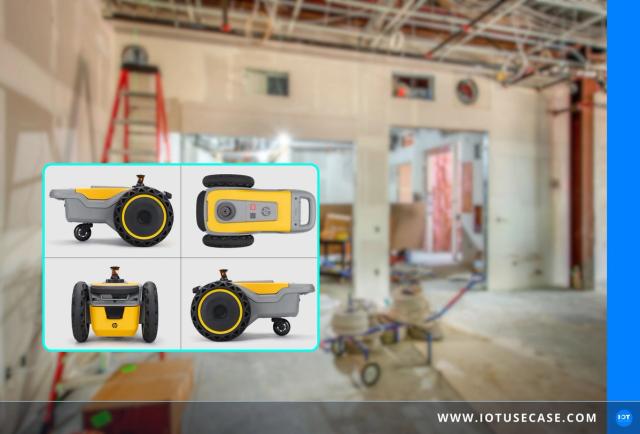



Construction layout robot with IoT: floor plans marked
The HP SitePrint navigates around obstacles using sensors and LiDAR and is linked to a total station that measures distances, angles and heights. CAD plans are loaded from the cloud and checked on site on a tablet, and changes go back to the cloud in real time. Notifications about the robot's condition and the ink tank level reach the service team immediately. Because building shells have neither Wi-Fi nor fixed lines, the connection runs over Deutsche Telekom's LTE network, worldwide via roaming agreements.
The examples come from construction. For the construction group Acciona, SitePrint marked almost two kilometres of drywall profiles across about 8,400 square metres at the Hospital Central do Alentejo in Évora, Portugal. A single operator achieved 225 m²/h compared with 40 m²/h manually, and the entire layout process was completed in 37 hours with an accuracy of under three millimetres. In exhibition stand construction, Berlin-based ArtLab Studios set up a stand covering 8,000 square metres at Messe Düsseldorf in 9 instead of 16 hours.
Construction layout robot: frequently asked questions
How accurate is a layout robot on a construction site?
HP SitePrint marks with an accuracy of under three millimetres. It takes the dimensions directly from the digital CAD drawings, so manual measuring with tape and chalk lines is no longer needed. A connected total station measures distances, angles and heights. On the hospital project for Acciona, the higher accuracy led to less rework and lower overall costs.
How much faster is a robot at construction site layout?
In the solution example, about six times faster than usual. At the Hospital Central do Alentejo, HP SitePrint achieved 225 m²/h, compared with 40 m²/h for the manual method with a two-person team. The entire layout process for almost two kilometres of drywall profiles was completed in 37 hours. This allowed workers to start installing the walls earlier.
How is a construction layout robot connected without Wi-Fi?
Via cellular network, because building shells have neither Wi-Fi nor fixed lines. HP SitePrint uses Deutsche Telekom LTE, and abroad it relies on roaming agreements with more than 600 partners. This lets the robot load CAD plans from the cloud and report its condition and ink level to the service team. HP has used it this way from Düsseldorf to Nunavut in Canada without new contracts for each country.
Is a construction layout robot useful for trade show stands?
Yes, wherever layout tasks arise. Berlin-based ArtLab Studios had to mark positions for lighting, sound and electrical systems across 8,000 square metres at Messe Düsseldorf. With HP SitePrint and just one person, the work was done in 9 instead of 16 hours. The more precise markings reduced errors, and last-minute changes could be incorporated without delaying the schedule.
More assets in “Machinery and Equipment”

Pump
Pump monitoring with IoT records vibration, temperature, pressure and energy consumption of running pumps. Operators detect damage and faults before a pump fails and plan maintenance by condition rather than at fixed intervals.

Compressor
With IoT, compressor maintenance follows actual condition: sensors record current consumption, pressure, temperature and running times. Operators detect creeping damage and unused running time early and cut energy and service costs.

Electric motor
Motor condition monitoring with IoT continuously measures the vibration, temperature and current draw of electric motors. Operators detect imbalance, bearing damage or winding faults early and replace motors based on condition rather than after a failure.

Packaging machine
OEE software automatically records run times, downtime, speed and rejects on packaging machines from the machine signals. Operators see where their lines lose performance, and machine builders use the same data for remote access and digital services.

Refrigeration system
A refrigeration monitoring system makes service plannable: temperatures, refrigerant circuit pressures, compressor status and energy consumption flow into a platform in real time. Operators and service partners detect faults early, avoid unnecessary site visits and reduce excess consumption.

Air conditioning system
Commercial air conditioning systems in offices, retail branches and data centres can be monitored remotely with IoT. Operators see energy consumption, temperatures and faults in one place, detect failing compressors or refrigerant shortages early and plan service visits precisely.
IIoT Use Case user group
What no project tells you
What did the project cost? Which sensor didn't survive in the field? How did you get maintenance on board? 300+ industrial users discuss questions like these with each other every month, openly and without vendors in the room.
Frequent topics in these projects, bring your questions:
- Condition Monitoring
- Digital Documentation
Online every month
Alternating tech and business focus
Users only
No sales pitches, exchange under NDA
300+ members
OT, IT and IIoT leads from industry