Beer
In a commercial brewery, IoT sensors measure the density, temperature and material properties of the beer directly in production. Breweries see values such as sugar and alcohol in real time instead of drawing samples and waiting for the lab.
Beer at a glance
Most frequent in the projects on this page
Users in these projects

Verified projects featuring Beer
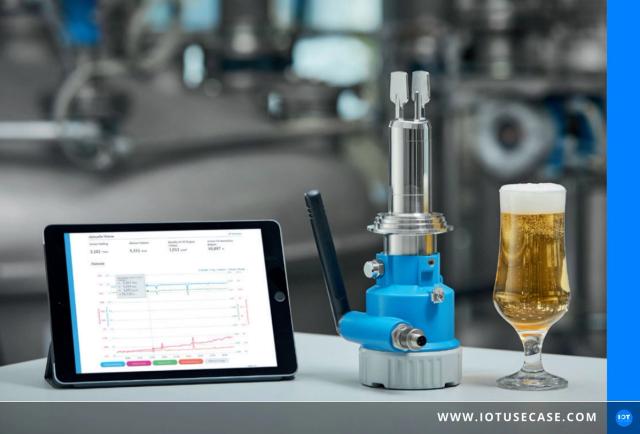




Commercial brewery: measure beer quality instead of drawing samples
The Endress+Hauser Fermentation Monitor QWX43 is a multisensor system for temperature, density, viscosity and speed of sound. It sits in the lower third of the tank above the cone; its IP66/67 housing contains the power supply and a web server that connects to the brewery's Wi-Fi. The readings go to the Netilion cloud platform, which displays them on a PC or smartphone, sends notifications when thresholds are reached and offers an API for custom applications. SONEM uses ultrasonic sensors to measure, without contact, how the signal propagates through the medium. An AI algorithm evaluates the data, and a MOXA gateway plus the AIT Smart Edge toolkit based on Azure IoT Edge bring it into the cloud.
The examples come from consumer goods and chemicals, with use cases such as temperature measurement and the structured availability of documents. With Endress+Hauser, accurate and repeatable measurements replace hydrometer readings and lab analysis; values are updated every minute and batches are saved automatically. SONEM tested its solution with a medium-sized German brewery, together with Microsoft, AIT and MOXA. The contactless method suits the hygienically sensitive brewing process and reveals potential for optimisation.
Commercial brewery: frequently asked questions
What does inline density measurement deliver in a brewery?
Inline measurement supplies readings such as temperature, density, viscosity and speed of sound, from which sugar, alcohol and the course of fermentation can be derived. The Endress+Hauser Fermentation Monitor QWX43 measures these values directly in the tank and updates them every minute. SONEM ultrasonic sensors also record how the signal propagates through the medium and compare it with a reference measurement. The result is a continuous picture of the process instead of individual spot checks.
How can brewery quality assurance be automated?
A multisensor system installed permanently in the tank measures the values from which sugar and alcohol can be determined, without anyone having to draw a sample. Previously, a sample was taken around once a day, carried to the lab and the result entered into a list by hand. This took time and carried a small risk of contaminating the tank. With IoT, the values can be called up at any time on any internet-enabled device.
What does brewery automation bring to beer quality?
IoT makes beer quality measurable throughout production instead of checking it only through individual samples. At SONEM, ultrasonic sensors compare the properties of the medium with a reference measurement, without contact and in real time. A machine learning model is continuously trained further with the data on a cloud platform. Endress+Hauser cites consistent beer quality and optimised use of raw materials as benefits of its Fermentation Monitor.
Which platforms do breweries use for monitoring process data?
Readings usually flow into a cloud platform that displays them in dashboards and raises alerts at limit values. Endress+Hauser uses its IIoT ecosystem Netilion, which also creates batches and readings automatically and allows custom applications via an API. SONEM relies on Microsoft Azure: data is pre-processed at the edge, analysed in the cloud and visualised for end customers in IoT Central.
More assets in “Fluids & Gases”

Compressed air
Compressed air leak detection with IoT continuously measures flow, pressure and compressor load, revealing leaks and unused running times. This cuts the cost of one of the most expensive forms of energy in manufacturing.

Indoor air
Indoor air quality monitoring with IoT means sensors continuously record CO₂, fine dust, particles, temperature and humidity and report limit violations immediately. Operators protect employees, safeguard product quality and heat and ventilate according to demand.

Drinking water
Water network leak detection for drinking water continuously measures pressure, flow and consumption with IoT and reports deviations immediately. Utilities find leaks, pipe bursts and water theft sooner and lose less drinking water.

Groundwater
Groundwater monitoring with IoT measures levels automatically and transmits them by radio to a platform. Authorities, utilities, construction sites and businesses with their own well replace manual measurements and are alerted to critical water levels or pump faults.

Wastewater
Wastewater flow measurement, levels and water quality can be recorded with IoT directly at pipes, basins and discharge points. Operators see wastewater volumes in real time, respond faster to faults and meet reporting obligations without daily sampling.

Molten metal
In foundry melting and vacuum metallurgy, IoT continuously records the melt pool, fill level, temperature and pressure of molten metal. Deviations show up before a batch becomes unusable or a furnace runs empty.
IIoT Use Case user group
What no project tells you
What did the project cost? Which sensor didn't survive in the field? How did you get maintenance on board? 300+ industrial users discuss questions like these with each other every month, openly and without vendors in the room.
Frequent topics in these projects, bring your questions:
- Condition Monitoring
- Digital Documentation
- Quality Management
Online every month
Alternating tech and business focus
Users only
No sales pitches, exchange under NDA
300+ members
OT, IT and IIoT leads from industry